-
So is the "gas checking" a process for hardening the projectile? I guess my real question is "What is gas checking?" (Hitting google now...)Leave a comment:
-
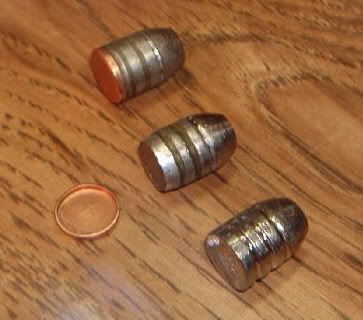
Oh no, the amount of info required for casting is equal or greater than that of reloading in general. Generally, as long as the projectile stays below 1100fps or so, it's going to be pretty easy. Once you get into higher velocities (1200+) you start to run into problems with leading. Gas checks are one way to prevent the combustion from melting the bullet. I gas check all my .501 projectiles in my 500 magnum to avoid that, and I shoot them at 1600fps or so. It can be done without gas checks in some circumstances but then you get into hardening your lead or you can paper patch, all of this gets more complicated. slower bullet speeds are much easier to cast for, .45 ACP for instance, since almost all bullets are around 800fps it's really easy to cast for.Originally posted by Darren M View PostLast edited by CJ; 12-09-2013, 08:35 AM.Leave a comment:
-
CJ, can you speak a little more to the casting process? I was just reading up on "gas checking" and am a bit confused about that requirement of non-jacketed projectiles. I assumed casting a new projectile was as simple as getting some lead, a cast, and making a fire... Not so much?Leave a comment:
-
I know it's late, but awesome thread right here. Will definitely be looking into thisLeave a comment:
-
yep, and it was stored for free until I got moved/settled into my house.Leave a comment:
-
Damn, I didn't realize it had been so long since I actually bought this. I finally got around to picking it up and taking some pics


Not pictured is a box of plastic cases for the completed rounds(and a bunch of empty cardboard boxes).Most of the stuff is for .270 and 30-06. The powder cans are all almost empty. I need to do some cleanup on the bench because a can of oil spilled in a few of the drawers.Leave a comment:
-
One thing to add...
Reloading is addicting! You will get hooked very quickly, especially when you realize you can make rifle ammo cheaper and more accurate than factory.
If you are new to reloading, I would highly recommend starting with an easy low pressure round like the 45acp. Big case mouth, lots of reloading data, lots of powders available (well usually), and pretty difficult to screw up. Personally, I would get comfortable reloading before moving to a higher pressure round like the 40 or 9mm.
Someone else mentioned this, but get a good set of calipers, and use them. Calipers will be needed to get your bullet seating die set to the proper OAL. This all depends on the caliber you are reloading, but it is critical that you get the OAL within the proper range. Also, get a good scale that measures grains.
Once you get started loading your caliber, I highly recommend checking a few things every now and then while you are loading. There is nothing worse than loading 500 rounds, only to find something was off and you have to pull bullets out and start over. Ask me how I know this.
For example, when you set your powder measure for your load, in theory it should stay right there. However, that is not always the case. If you are loading 25.5 grains of Ramshot Tac in .223 case, you want it to stay pretty close to that. About every 50th round, load the powder and before you seat the bullet weigh the powder in the case. Pour the powder into the little tray and make sure that you are still at 25.5 grains (give or take a tenth or two).
Also about every 50th load or so, check the OAL. Again, theoretically your bullet seating die should stay where it is, and every load should have the same OAL (overall length). Load your powder and seat a bullet, then pull that round out and check the OAL. Make sure that you are making all your bullets the length you want them.
Finally, and especially if you are using a progressive press, PAY ATTENTION! Have a good light shining down on your work, especially where your powder goes into the case. Eliminate any distractions and concentrate on what you are doing. One of the mistakes that reloaders make is to "double charge" a case. Some powders and calibers will not let you do this. If you accidentally double charge, or put twice the amount of powder you need in a case, the powder will spill out all over the place and you will know that you double charged a case. But this is not always the case. For example, Bullseye uses less powder, and you can double charge a .40 cal case without it spilling over. You can imagine the problem this could cause if you ever shot a high pressure, double charged case. I visually inspect the inside of each case as I put the bullet on top of the case to make sure that the approximate amount of powder is in the case. This only takes about 1 sec to do, and it is simply a means to add safety to my loads.
Sorry if this is long winded, but reloading is a passion that I hope anyone reading this thread will get into and enjoy. I only reload 9mm, 40, 45acp, and 223, and I have a Dillon RL 550b. If I can ever help, don't hesitate to ask.Leave a comment:
-
Went ahead and bought it. All the hardware is Lyman branded. Die sets for .223, .243, .270, 30-06, 38sp, and a few others that were stacked in the cabinet. A drawer full of projectiles - all Hornady and fairly old looking. A few 25 lb sacks of bird shot for 12ga. reloads. Various primers and plastic cases, there was a little bit of powder(not sure the condition), and a decent size work bench. There's more but I didn't dig through it all yet. I'm gonna move it soon and inventory it all to see what I have.
The press is a old Lyman ST turret press. Not really what I was wanting to use, but it is considerably cheaper than what I was looking at(Hornady LnL ). Now if I find I like reloading, I'll probably buy a nice progressive press.Leave a comment:


Leave a comment: